Cancer begins in one place. But sometimes, it doesn’t stay there.
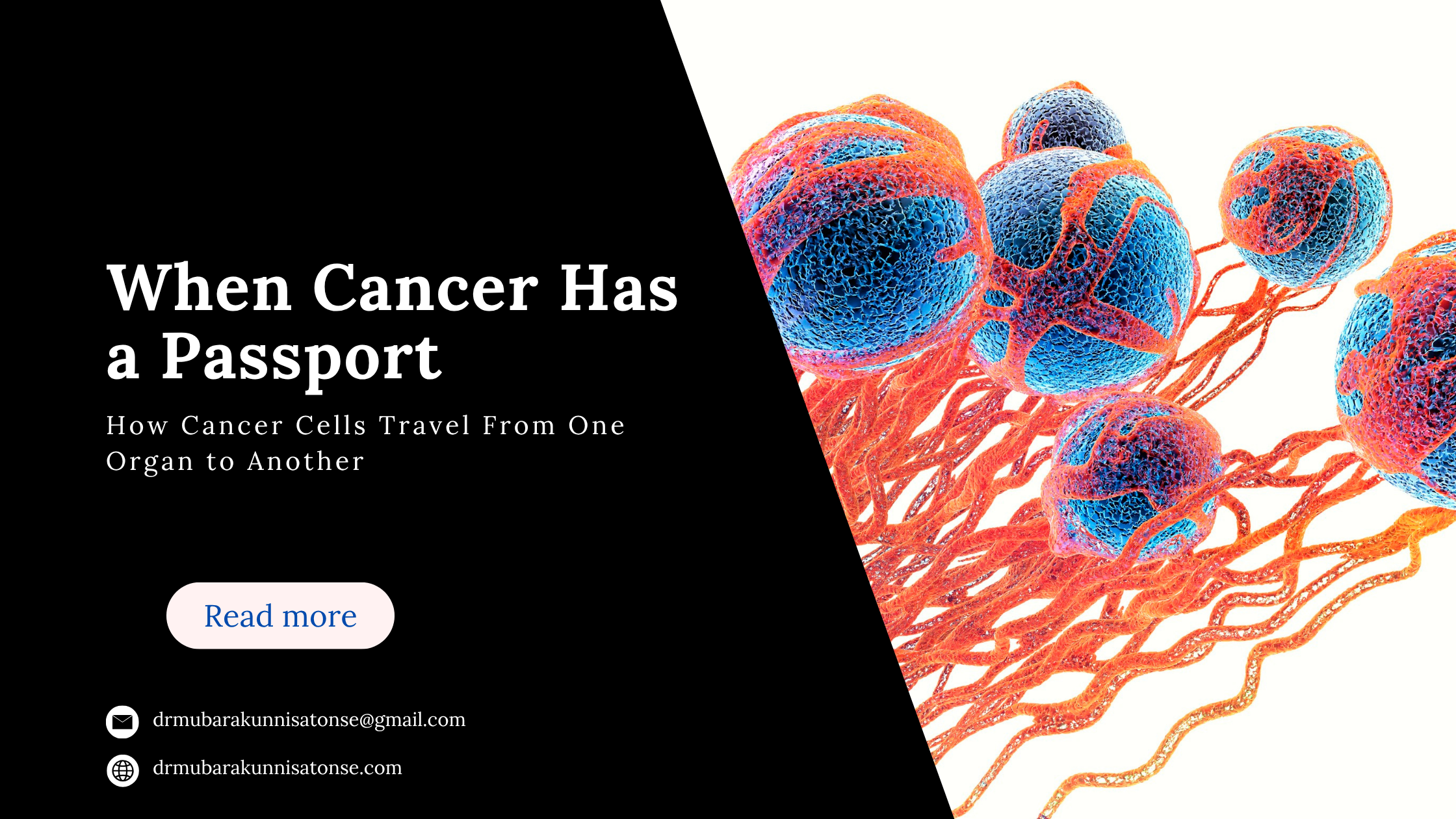
When cancer cells move from the original tumor to another part of the body, the process is called metastasis. It is one of the most complex and important developments in cancer biology.
But how does a microscopic cell leave one organ, survive a journey through the body, and begin growing somewhere completely different?
The First Step: Leaving Home
Most cancer cells remain within their original tumor.
Some, however, acquire the ability to break away from neighboring cells and invade surrounding tissue. From there, they may enter nearby blood vessels or lymphatic vessels.
This is not an easy journey.
The body’s circulation is a hostile environment, and many cancer cells do not survive it.
The ones that do face another challenge: finding a place where they can survive and grow.
The Journey Through the Body
Once cancer cells enter the bloodstream or lymphatic system, they can potentially travel to distant organs.
But reaching another organ doesn’t automatically mean metastasis.
A cancer cell must:
- Survive the journey
- Exit the blood or lymphatic vessel
- Enter surrounding tissue
- Adapt to its new environment
- Obtain nutrients and support
- Establish a new population of cancer cells
This is why metastasis is a complex biological process rather than simply “cancer spreading.”
Why Does Cancer Spread to Certain Organs?
An intriguing question in oncology is why some cancers tend to spread to particular organs.
For example, breast cancer may spread to the bones, liver, lungs, or brain. Colorectal cancer commonly spreads to the liver and lungs.
Researchers believe this involves a combination of blood flow, molecular signals, and interactions between cancer cells and the tissues they encounter.
In other words, cancer cells don’t simply travel randomly.
The environment of the destination matters.
Scientists sometimes describe this relationship using the concept of the “seed and soil”: cancer cells are the seeds, while certain organs may provide conditions that allow those cells to grow.
A Metastatic Tumor Is Still the Original Cancer
This is an important distinction.
If breast cancer spreads to the liver, the tumor in the liver is still metastatic breast cancer, not liver cancer.
If colon cancer spreads to the lungs, it remains metastatic colorectal cancer.
The cancer cells retain characteristics of the original cancer, which is why treatment is generally based on the primary cancer and its biological features.
Why Metastasis Changes Cancer Treatment
Once cancer has spread to distant organs, treatment planning often becomes more complex.
Doctors may consider systemic treatments such as chemotherapy, targeted therapy, immunotherapy, hormonal therapy, or combinations of treatments depending on the cancer type and its molecular characteristics.
The goal may include controlling the cancer, reducing symptoms, slowing progression, and maintaining quality of life.
Importantly, metastatic cancer does not mean that treatment is no longer possible. Many advanced cancers can be treated and controlled for meaningful periods, although the outlook varies greatly between cancer types and individual patients.
Cancer spreading from one organ to another is not a simple journey.
A cancer cell must escape its original environment, survive the circulation, enter another tissue, and convince that new environment to support its growth.
Understanding metastasis helps explain why cancer treatment is about more than removing the original tumor.
Sometimes, the most important question isn’t simply “Where did the cancer begin?”
It is “Where has it travelled, and what is it doing there?”