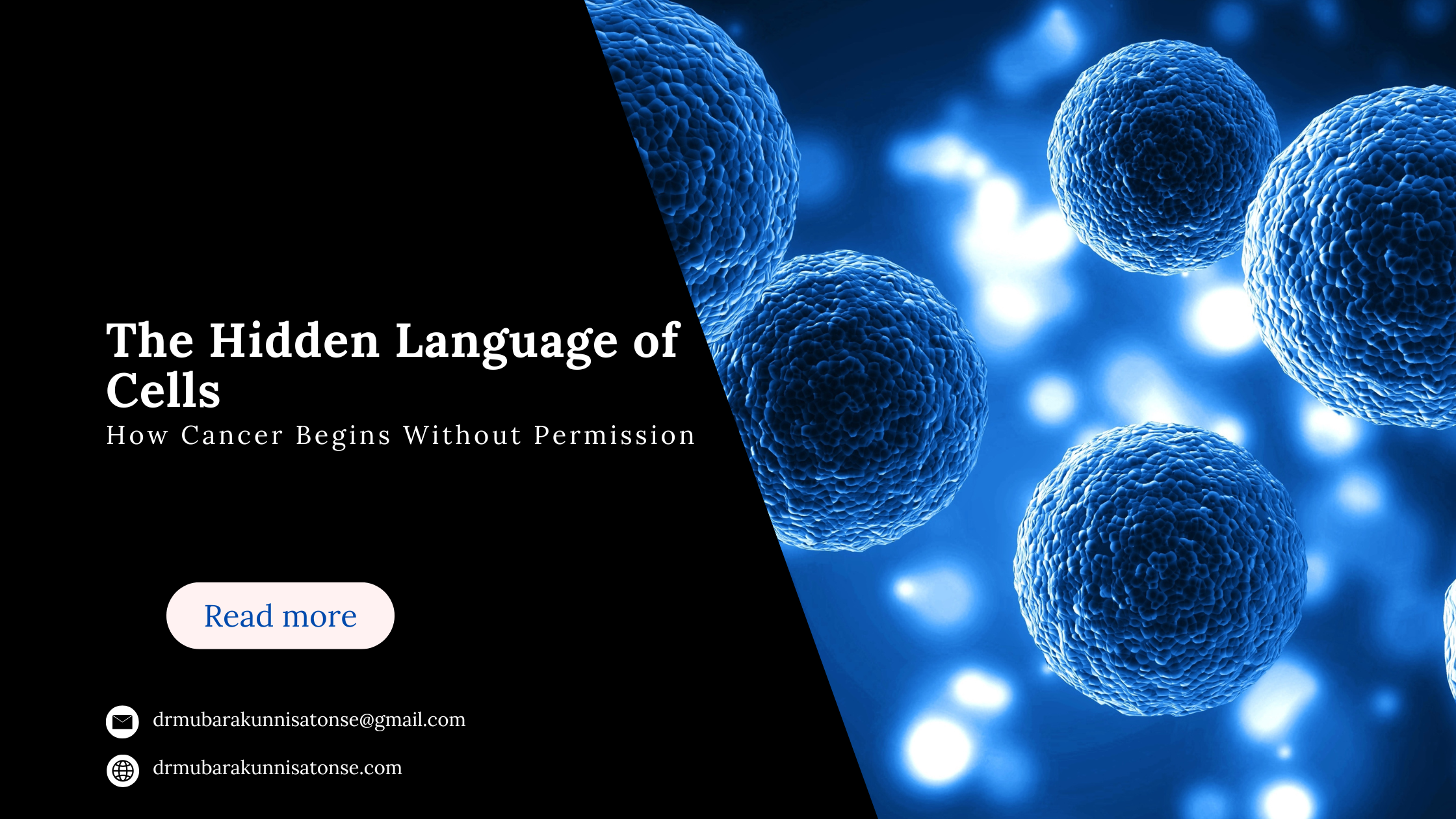
Your body is having billions of conversations right now.
Not through words, but through microscopic messages exchanged between cells every second. These conversations tell cells when to grow, when to repair themselves, when to divide, and even when to die.
For most of our lives, this silent communication is remarkably accurate. It keeps our organs functioning, heals injuries, and replaces old cells with new ones.
But cancer begins the moment one cell stops listening.
It doesn’t ask for permission. It doesn’t make an announcement. It simply starts rewriting the rules.
Every Cell Has a Job—and a Rulebook
The human body contains nearly 37 trillion cells, each programmed with a specific role. Whether it’s a skin cell, a lung cell, or a liver cell, every one follows instructions stored in its DNA.
These instructions ensure that cells:
- Grow only when needed
- Repair damaged DNA
- Work together with neighboring cells
- Stop dividing when their task is complete
- Self-destruct if they become too damaged
This carefully coordinated system keeps the body healthy and in balance.
When One Cell Breaks the Rules
Throughout life, our cells are exposed to constant challenges, including aging, pollution, tobacco smoke, ultraviolet rays, infections, and random errors during normal cell division.
Most of the time, the body repairs this damage before it causes harm.
But occasionally, a mistake slips through.
A damaged cell may ignore the signals that normally control its behavior. Instead of stopping when instructed, it keeps dividing. Instead of repairing itself, it accumulates more genetic errors. Instead of dying, it survives.
At first, this change affects only one cell.
Over time, however, that single cell can produce thousands, then millions, of abnormal cells.
Cancer doesn’t begin with a tumor.
It begins with a conversation that quietly falls apart.
Why the Body Doesn’t Always Notice
People often wonder why the immune system doesn’t immediately destroy cancer cells.
The answer is that early cancer cells are remarkably similar to healthy cells. They originate from our own tissues and can disguise themselves, making them difficult for the immune system to recognize.
Scientists call this immune evasion.
As abnormal cells continue to multiply, they develop new ways to avoid detection, allowing them to grow silently for months or even years before causing noticeable symptoms.
Cancer Is a Process, Not an Event
One of the biggest misconceptions about cancer is that it appears suddenly.
In reality, cancer usually develops gradually.
A single mutation rarely causes disease. Instead, multiple genetic changes accumulate over time, slowly disrupting the normal communication between cells.
This explains why many cancers take years to develop and why the earliest stages often produce no symptoms at all.
Understanding this process also explains why early cancer detection is so important. Finding abnormal changes before they become advanced offers the greatest opportunity for successful treatment.
Listening Before the Body Speaks
The hidden language of cells reminds us that health isn’t simply the absence of symptoms.
Important biological changes can begin long before pain, fatigue, or a lump appears.
That’s why regular health check-ups, appropriate cancer screening, and awareness of persistent changes remain essential, even when you feel well.
Medicine today is not only about treating cancer. It’s about recognizing when the body’s internal conversations begin to change.
Final Thoughts
Cancer doesn’t arrive with permission.
It begins quietly, when a healthy cell gradually stops responding to the signals that keep billions of other cells working together.
By understanding how cancer begins at the cellular level, we shift our focus from reacting to disease to recognizing it earlier.
Because every cancer has a beginning.
And every beginning starts with a single cell that stopped listening.